
As 1986 began, the NSW Independent Teachers Association (ITA), as our union was then known, had 12,103 members – and 2035 more joined throughout the year. Today we have more than 32,000 members.
Of those who joined in 1986, 85 are still members and will receive their 40-year membership gift this year. It was the United Nations International Year of Peace in 1986 – food for thought 40 years later.
The year’s agenda
ITA General Secretary Michael Raper laid out the union’s agenda for 1986, including:
- growing union membership
- changing the ITA’s rules to allow election of chapter committees. Many schools elected chapter secretaries and chairpersons for the first time to support their chapter rep
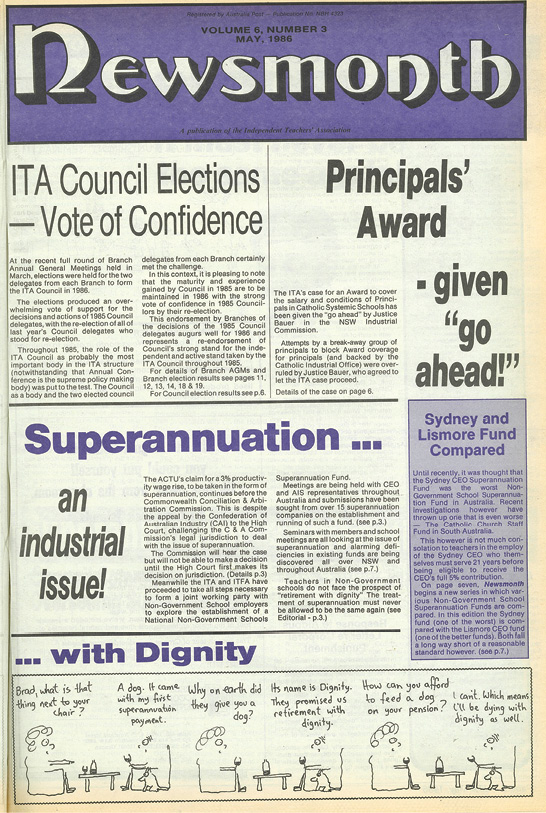
- achieving superannuation for members (see May 1986 Newsmonth, above left)
- clarifying face-to-face teaching hours in Catholic systemic primary schools
- purchasing the ITA’s new premises in Day St, Sydney, which opened on 27 September 1986
- registering as a federal union (rather than state jurisdiction): the High Court ruled that the Independent Teachers Federation (ITF) could be registered as a federal union for non-government school teachers
- opposing funding cuts to early childhood services: a national day of action was called on 5 March 1986 and childcare centres throughout Australia took part. More than 1000 people joined a rally at Martin Place to protest the funding cuts.
Taking action
The Vatican announced that two new dioceses were to be formed – Broken Bay and Parramatta – from parts of the Archdiocese of Sydney.
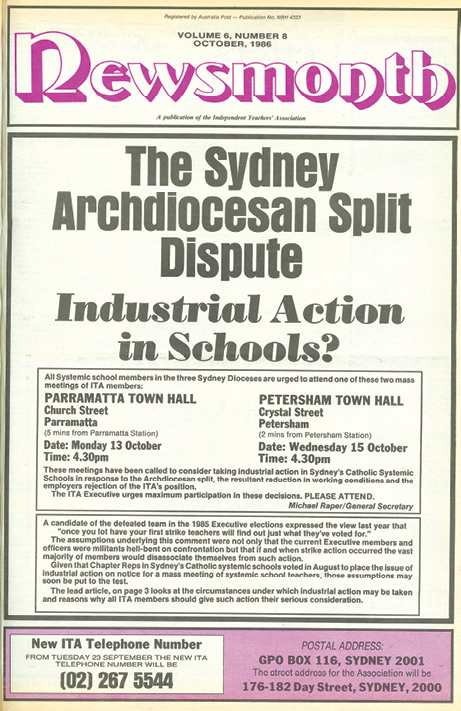
Mass meetings of members were held in October at Parramatta Town Hall and Petersham Town Hall to discuss taking industrial action to ensure that sick leave and long service leave benefits would be portable to the two newly created dioceses (see October 1986 Newsmonth cover, above right).
Across the two meetings, 270 members voted to take industrial action while 155 voted against.
This represented 63.5 per cent of members in favour; however, the ITA’s constitution at the time required a two-thirds majority (66.6%) for industrial action to be authorised.
In the ACT, the Independent Schools Staff Association (ISSA) negotiated the Teachers (Non-Government Schools) (ACT) Award – the first award to cover non-government schools in the ACT. ISSA amalgamated with the IEU in 2003.
Facing punishment
Corporal punishment of students in NSW government schools was in its final year in 1986.
The ITA executive unanimously passed a motion stating: “Corporal punishment has no place in education and should be banned in all non-government schools.”
However, not all members agreed and letters defending corporal punishment appeared in Newsmonth. See ‘from the archives‘ below.
Salaries snapshot
A summary of salaries in 1986:
- first-year-out teacher (two-years trained) $17,140
- top-step teacher (four-years trained) $24,955
- Catholic systemic lay principals $32,915 to $44,885.
Nation and culture
A snapshot of people, politicians, movies and music:
- Prime Minister: Bob Hawke
- Federal Education Minister: Susan Ryan
- NSW Premier: Neville Wran followed by Barrie Unsworth
- NSW Education Minister: Rodney Cavalier
- NSWRL Premiers: Parramatta Eels
- VFL Premiers: Hawthorn
- Academy Award Best Picture: Out of Africa
- Booker Prize: The Old Devils, Kingsley Amis
- Countdown Music Awards: Best Album: Whispering Jack, John Farnham; Best Single: You’re the Voice, John Farnham
- Australian of the Year: Entrepreneur Dick Smith
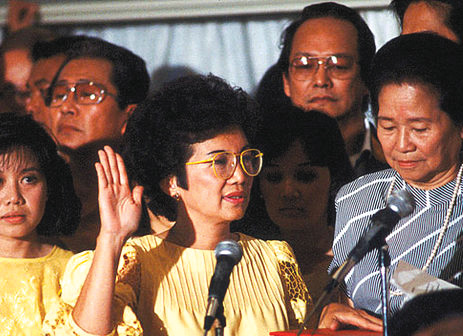
- Time magazine’s Person of the Year: First female president of The Philippines Corazon Aquino.
From the archives: Banning the ‘caring’ cane
“The past is a foreign country; they do things differently there” wrote L.P. Hartley in his 1953 novel The Go-Between. This was evident in 1986 when Newsmonth featured the union’s call to abolish corporal punishment.
That year, members of the Independent Teachers Association, as the IEU was then known, wrote letters to the editor opposing the abolition of corporal punishment in schools.
The first issue of Newsmonth in 1986 featured an article by Professional Officer Barbara McGarity entitled Discipline, which included a motion from the ITA Executive calling for an end to corporal punishment in non-government schools.
“All but the staunchest diehards will now agree that corporal punishment has nothing to do with education,” she wrote.
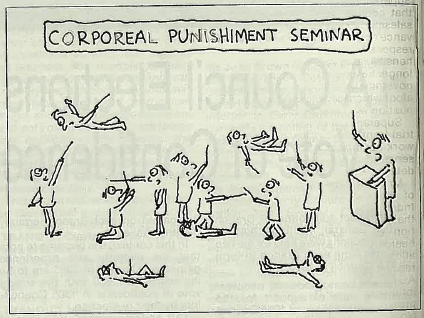
A colourful exchange of letters followed; some members were deeply offended by the union’s stance.
One member said he was “incensed” by McGarity’s article.
“I am incredulous at her suggestion to seek the advice of a psychologist: I thought only Russians sent dissenters for such re-education,” he wrote.
“The majority of parents support the judicious and careful use of the cane.”
Another member called McGarity’s story “a slur on many dedicated, caring teachers – teachers who are prepared to undertake an unpleasant task in the interests of their students”.
He further claimed that 80 per cent of staff at his secondary school did not want corporal punishment abolished.
McGarity hit back (so to speak): “[The member] seems to have made the mistake of confusing punishment with discipline.
“If violence is evil, then corporal punishment in schools is an aberration,” she wrote.
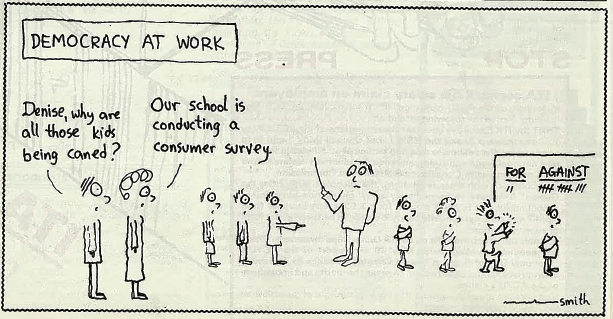
Our cartoonist depicted the debate vividly in Democracy at Work, which showed a ‘consumer survey’ of students lining up to be caned.
Amid the furore, ITA member John Quessy expressed support for the “sensible and sensitive statement” from the union’s Executive. John, of course, went on to become Secretary of the IEU in 2012.
To cane or not to cane, that question is settled.
The fight for fair pay and conditions continues.
Published in the May 2026 edition of Newsmonth. Compiled by Dave Towson (Deputy Secretary), Monica Crouch (Managing Editor) and Tania Yardley.
More IEU History
-

Time capsule: 1986
As 1986 began, the NSW Independent Teachers Association (ITA), as our union was then known, had 12,103 members – and 2035 more joined throughout the year. Today we have more than 32,000 members. Of those who joined in 1986, 85 are still members and will receive their 40-year membership gift this year. It was the…
-

Time capsule: 2015
In 2015, former US President Barack Obama still occupied the White House. The Lodge in Canberra, however, had new tenants after Malcolm Turnbull successfully challenged Tony Abbott for the prime ministership after the Abbott-led government recorded 30 consecutive losses in Newspoll. The ‘fixer’, Christopher Pyne, was the federal education minister, while his NSW counterpart was…
-

Time capsule: 1985
They’re probably not two people you’d expect to see in the same sentence, but the year was 1985, and China’s leader Deng Xiaoping was the Time Person of the Year while actor and comedian Paul Hogan was Australian of the Year. It was a big year for literature, with author Margaret Atwood publishing The Handmaid’s…
-
Time capsule: 2005
Prime Minister John Howard was at the height of his power in 2005 after his government attained a majority in the Senate following the previous year’s federal election. However, 2005 marked the beginning of the end of the federal Coalition government after it introduced draconian industrial relations legislation. Dubbed WorkChoices, it sought to severely restrict…
-

Time capsule 1995
In a semi-regular column, we delve into our Newsmonth archives to uncover what stood out in the union, the teaching profession and the education sector, as well as politics and culture. Here we wind the clock back 30 years to 1995. It was a year when Paul Keating ruled the roost in Canberra, while Bob Carr began…
-

Statement on the passing of John Quessy
The IEU is deeply saddened by the passing of former Secretary John Quessy on Sunday 10 December. John joined the Independent Teachers Association (now the NSW/ACT Branch of the IEUA) as a student member in 1975. He became a teacher at St Pius X Chatswood from 1976 to 1994, where he taught English, history, art…
-
Time capsule 1981
In a semi-regular column, we delve into our Newsmonth archives to uncover what stood out in the union, the teaching profession and the education sector, as well as politics and culture. Here we wind the clock back 40 years to 1981. In 1981, the IEU was known as the Independent Teachers Association (ITA), boasting a total membership…