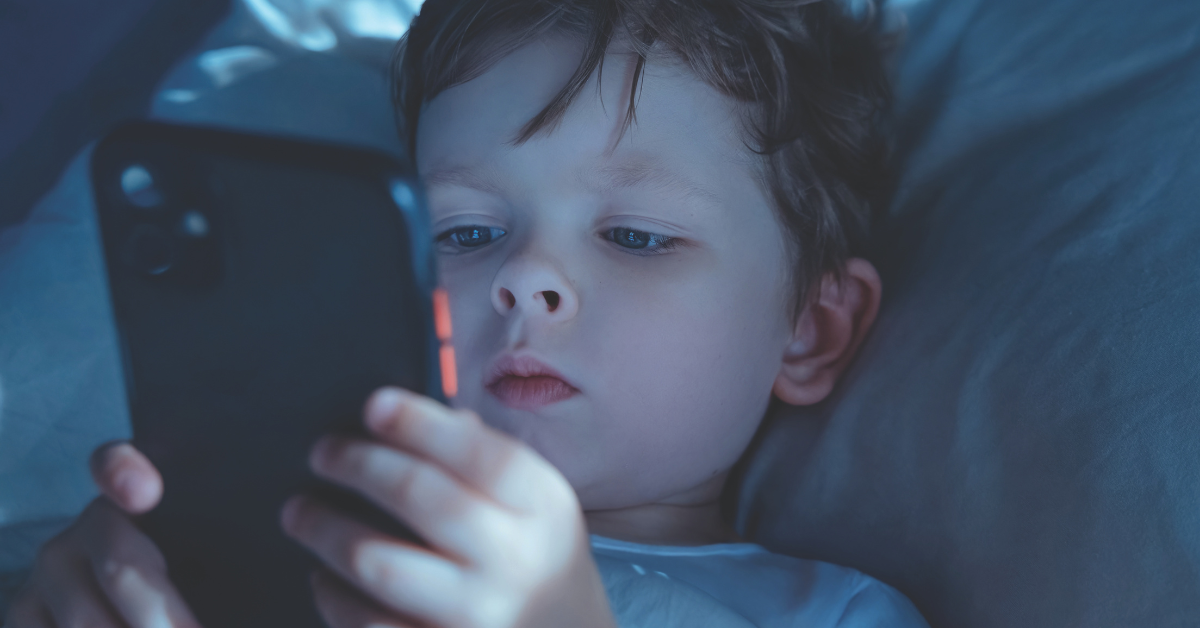
Preschoolers are struggling to understand social cues, make friends and regulate their emotions because of excessive screen use, writes Andrew Taylor.
Children are starting preschool with frozen faces and are unable to express their emotions because of the amount of time both they and their parents spend looking at screens.
This is one of the findings of neuroscientist Dr Mark Williams who says the overuse of devices has left some toddlers with the “still face effect” – an inability to receive social cues, make social connections or learn to self-regulate.
“We used to see this mostly in children who had experienced severe trauma, like physical or sexual abuse,” he says.
“But now we’re seeing it far more widely in the general population.
“It means you lose the ability to use your face to express emotion.”
Williams says the facial expressions of parents and carers are crucial to young children’s learning and development.
Yet when a baby or toddler is met with a blank face staring at a screen rather than a smile directed at them, they do not learn to associate various reactions with different emotions.
“When they get to preschool they use this neutral face to try to make friends but when the other toddler sees a neutral face, he’s like, ‘oh that’s weird’ and walks away – so these kids have a lot of trouble making friends,” Williams told The Daily Telegraph.
Serious harm to learning
The “still face effect” is one of the consequences of excessive screen use that Williams documents in Screen Smart Children, co-written with teacher Gavin McCormack.
An honorary professor at Macquarie University’s School of Psychological Sciences, Williams says the book shows the serious harm to children’s learning and development caused by overuse of devices as well as providing practical tips to combat them.
The book draws on research and examples from the classroom to show how excessive screen use by young children and parents leads to anxiety, inattention, behavioural issues, speech problems, poor memory and learning difficulties.
Williams also highlights the reversal of the Flynn effect – an improvement in intelligence from one generation to another – in the past decade.
Williams says the fall in IQ has occurred in specific areas: verbal comprehension; perceptual reasoning; and perceptual organisation.
“It’s plausible that the new devices are the culprit when it comes to our decline in intelligence,” he writes in the chapter Getting dumber. “Especially when you factor in the number of hours our kids are on their devices at school as well.”
Renowned neuroscientist Baroness Susan Greenfield in her 2014 book Mind Change explored how digital technologies affected our brains, prompting controversy over her suggestion that the impact was comparable to climate change.
Subsequent research has vindicated Greenfield’s arguments about technology rewiring us in ways that Williams says are concerning.
“This generation is going to be the first generation that is less intelligent than their parents, which is really scary,” he says.
Williams says excessive screen use is more harmful for younger children because their brains are still developing.
Impact on teachers
Williams says staff in early childhood education bear the brunt of “still face effect” and other consequences of excessive screen use.
“You’re going to have more behavioural issues because children will be used to being positively reinforced constantly, which doesn’t happen in real life,” he says.
“You’re going to get kids who are less able to regulate their emotions and less likely to sit down and play with blocks or whatever.”
Williams says children are increasingly exhibiting speech delays because they are given devices rather than learning how to communicate properly by chatting to their parents. Research even shows young children are speaking less than previous generations.
“They’re not playing with siblings or friends regularly, so they’re not learning to communicate or interact, which causes problems at preschool,” he says.
Attention issues are also more likely to arise in young children due to overuse of screens.
“If your attention mechanisms aren’t working, you’re going to have trouble with memory storage,” Williams says.
“They’re not going to be able to retain as much information as children used to be able to.”
Williams says a lack of attention means teachers must change the way they give instructions to students.
“Instructions will have to be broken down because the working memory and attention mechanisms aren’t as good,” he says.
“So therefore, you have to give constant reminders because they’re not going to remember as much information.”
Addictive by design
Despite his concerns about excessive screen use, Williams is adamant he is not a technophobe.
“The problem at the moment is a lot of technology is designed to capture and hold our attention so that a few multinational companies can make huge amounts of money,” he says.
In March, a California jury found social media platforms Instagram and YouTube were designed to be addictive. The court awarded millions of dollars in damages to the plaintiff, a young woman who said her social media addiction as a child exacerbated her mental health issues.
Williams is also critical of edtech, or educational technology such as software, online platforms and digital content used in teaching.
He says edtech often relies on gamifying learning to prolong engagement by offering intermittent rewards: “Most people don’t know that gamified actually means using reinforcement schedules to get someone addicted.”
Williams is not alone in warning about the potential harms of technology.
Safe, ethical use
The IEU advocated for the safe, ethical and pedagogically sound use of technology, including artificial intelligence (AI) and edtech in its submission to the Productivity Commission’s 2025 interim report Building a skilled and adaptable workforce.
The submission said good faith consultation and agreement with employees and their unions “is vital if AI and edtech are to deliver workload relief and improvements in learning outcomes”.
The federal Department of Health warns sedentary screen time during early childhood can have long-term impacts on a child’s development. This includes shorter attention spans, delays in developing language skills and leaves children less ready for school.
It recommends no screen time for children under two years, and no more than one hour a day for children aged two to five.
Published in the June 2026 edition of Bedrock.