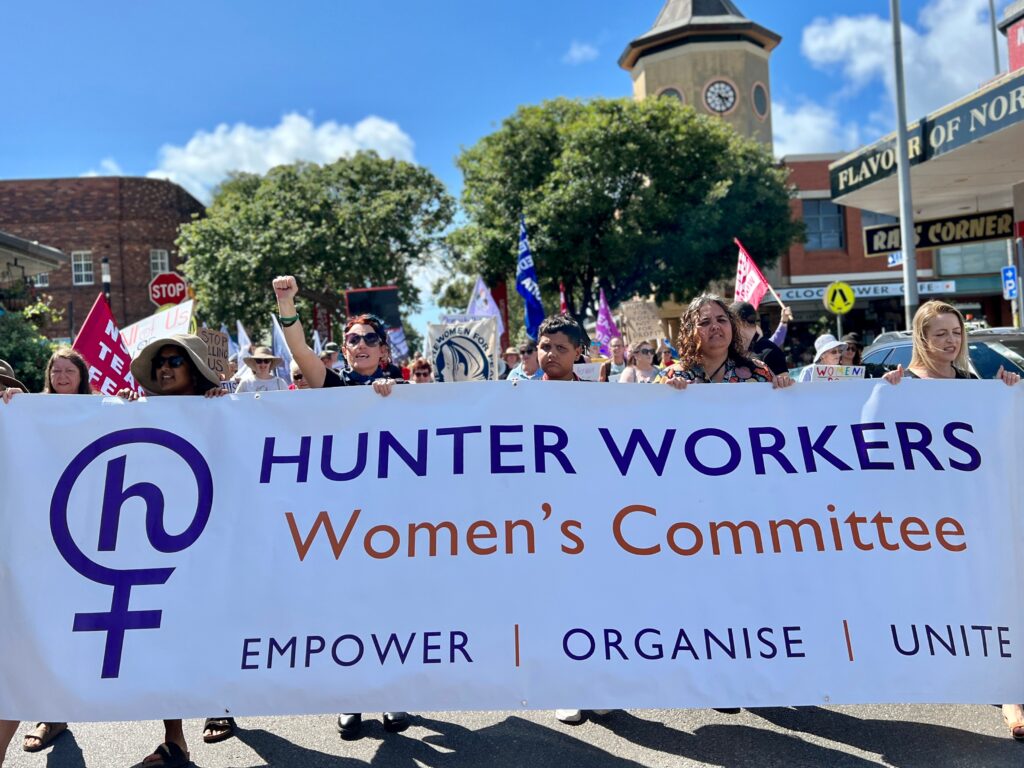
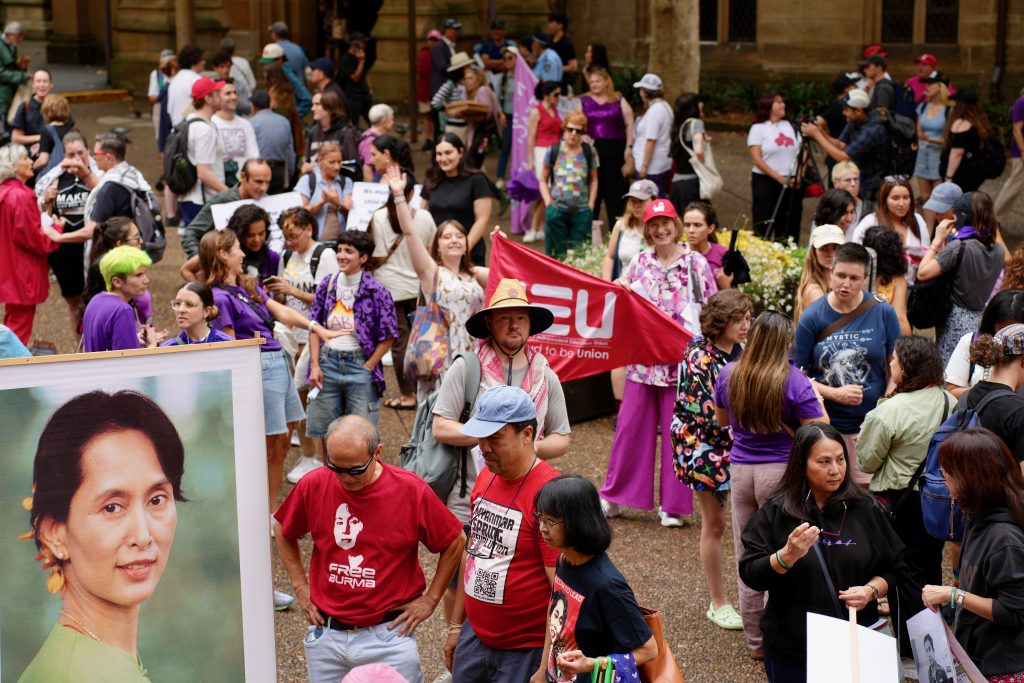
The IEU NSW/ACT Women and Equity Committee is a part of the national IEU Women and Equity Committee network. The Women and Equity Committee is involved with the Unions NSW and Unions ACT Women’s Committee and, more broadly, in the Australian Council of Trade Union’s (ACTU) Women’s Committee.
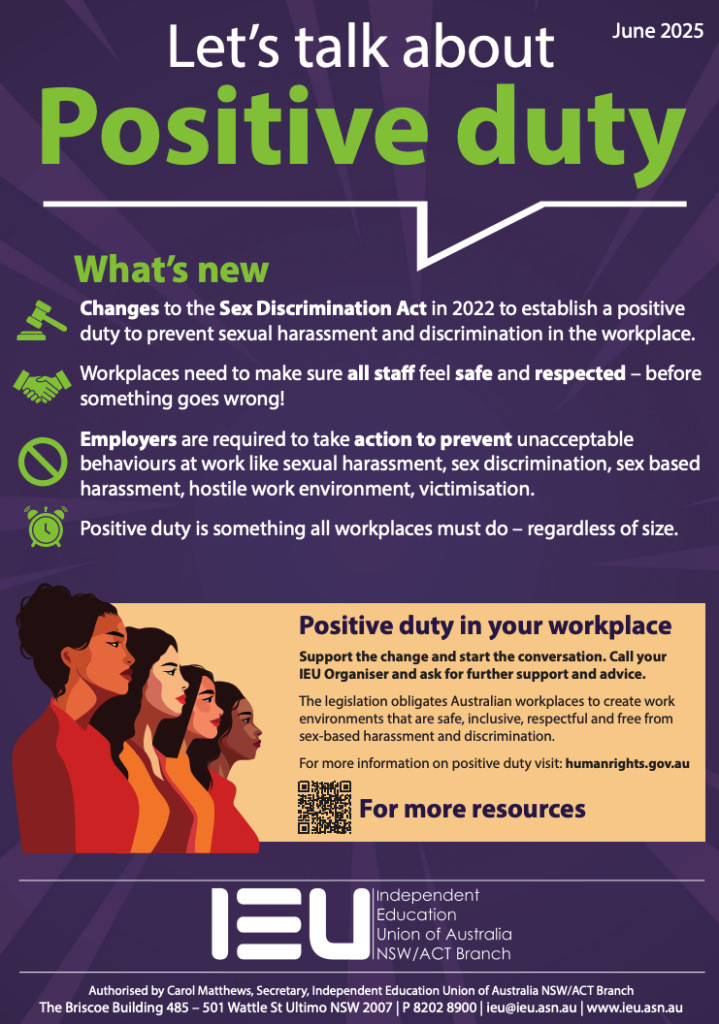
As a result of pressure from unions, including the IEU, positive duty reforms to the Sex Discrimination Act were introduced in December 2022. Employers now have a positive duty to prevent sex-based harassment and discrimination requiring them to take proactive, preventative action. Download our Positive Duty poster
The Women and Equity Committee participates in and promotes initiatives aimed at progressing gender equality and addressing the disparities and discrimination faced by women in various aspects of their professional lives.
The Committee works to raise awareness of women’s rights, equal opportunities, and access to resources.
The Committee currently promotes initiatives to address some of the following issues:
Closing the Gender Pay Gap: Addressing and reducing the wage gap between men and women for equal work or work of equal value
Equal Representation: Encouraging and supporting women’s participation and leadership in all spheres of their work
Creating equal accessibility to educational opportunities women and girls
Ending Gender-Based Violence: Combating violence and abuse against women and promoting safe environments for all members
Advocating and activating the role of work-life balance: By implementing policies and practices that support work-life balance, such as career progression which allows for parental leave, flexible work arrangements, and affordable childcare
Women’s Economic Empowerment: Creating opportunities for women to access economic resources and financial services through improvements to parental leave entitlements, affordable healthcare accessibility and superannuation
Discrimination: Eliminating all forms of discrimination against women, including cultural, social and age barriers
Reproductive Rights: Supporting women’s reproductive rights and access to family planning services by advocating for reproductive and menopausal leave
Intersectionality: Recognising and addressing the unique challenges faced by women from diverse backgrounds, such as women of colour, LGBTQI+ women, women with disabilities, and culturally and linguistically diverse (CALD) women
Improving employment opportunities that are gender sensitive: for all Aboriginal and Torres Strait Islander women
Advocacy and Policy Changes: Lobbying for legislative and policy changes that promote gender equality, improving legislation protecting women’s rights
These are just some examples of the components of the work of the Women and Equity Committee. Our work varies depending on specific agendas, context, cultural norms, and societal challenges faced in different areas of metropolitan and regional NSW/ACT at any given point.
Our goal is to create more inclusive, equal opportunity workplaces where women can thrive regardless of their gender.
Union history: women
Historically, women have played an important role in the union movement — organising, leading, and fighting for fair pay, safe workplaces and equal rights, even when their contributions went unrecognised. Today, women make up 72% of the IEU’s 75,000 members nationwide. As we honour the courage and determination of the women who shaped our union history, IEU members continue to organise, unite and mobilise for gender equality and better working conditions.
28 October 2023: Leadership change introduces IEU’s first female secretary – IEU history
The IEUA NSW/ACT Branch welcomed Carol Matthews into the role of Secretary after a unanimous vote at its Council meeting on 28 October 2023. The vote came after Mark Northam, Secretary since 2019, stepped down from the role. See media release and IEU History for more!
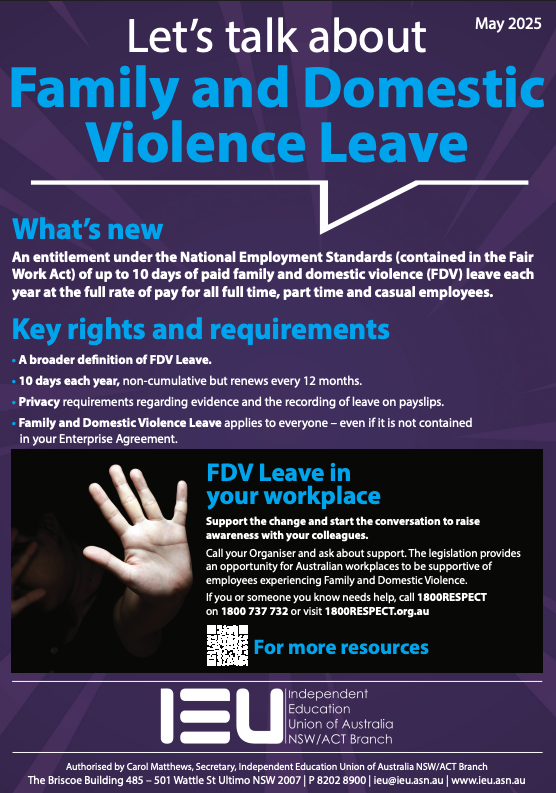
1 February 2023: 10 days paid family and domestic violence leave
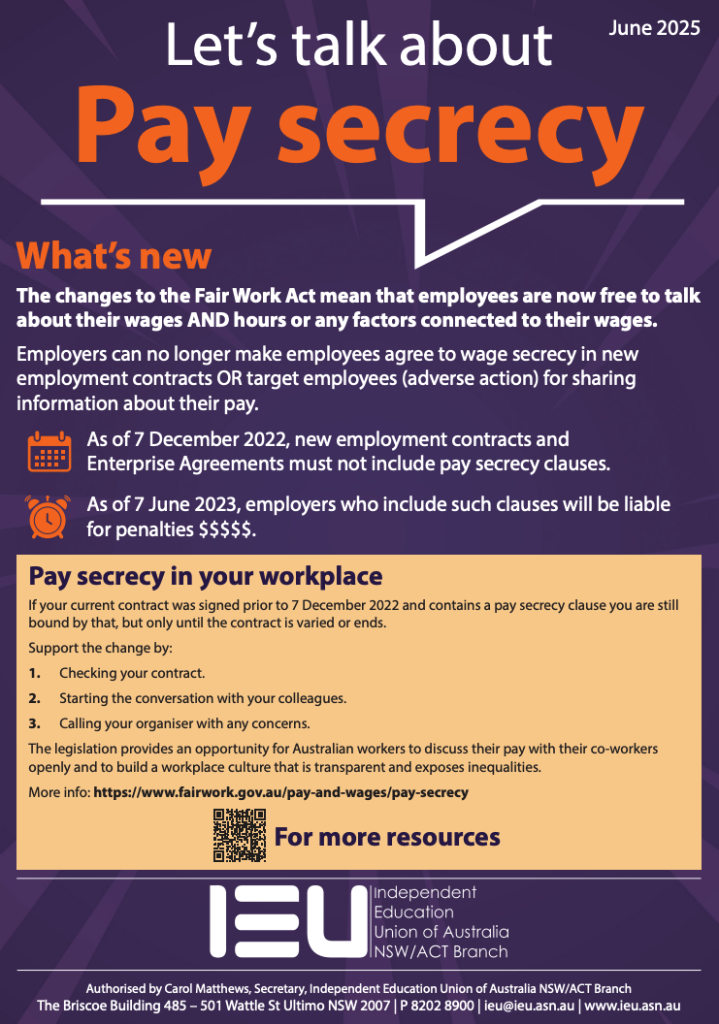
New employment contracts and Enterprise Agreements made after 7 December 2022 are not allowed to contain pay secrecy clauses. As of 7 June 2023, employers who continue to include pay secrecy clauses in new written agreements and employment contracts are liable for penalties. See Women and Equity Resources for a downloadable fact sheet on Pay Secrecy
December 2022: Positive Duty to prevent sexual harassment in the workplace
Changes to the Sex Discrimination Act were made in December 2022 to establish a positive duty to prevent sexual harassment and discrimination in the workplace. Employers are required to take action to prevent unacceptable behaviours at work like sexual harassment, sex discrimination, sex based harassment, hostile work environment, victimisation. See Women and Equity Resources for a downloadable fact sheet on Positive Duty
September 1995: Jennie George becomes first woman President of ACTU
In September 1995, Jennie George became the first woman to be elected as President of the Australian Council of Trade Unions. Read more on the ACTU history blog
1974 Equal Pay Case: putting an end to separate minimum wages based on gender (AUS)
In the 1970s, women unionists put an end to the discriminatory practice of separate minimum wages based on gender. Until 1974, women workers were excluded from the minimum wage. The 1974 Equal Pay Case challenged the prevailing notion of the “family wage” and affirmed the principle that women should receive equal pay for their labour.
The ruling was the result of many decades of women unionists like Edna Ryan and Muriel Heagney, as well as their allies, campaigning for equal pay.
The 1974 Equal Pay Case was a historic victory for union members and working women.
The gender pay gap still exists, and achieving true equality remains the mission of all unionists.
1971: Unions win Maternity Leave
Prior to 1970, there was no single general standard of maternity leave. In 1973, union advocacy secured three months’ paid maternity leave for federal public servants under the Whitlam Government. In 1979, an ACTU test case won 52 weeks of maternity leave, despite fierce opposition from employers and conservative groups.
Major milestones since 1979 have included:
1985: this right to a leave period was extended to adopted mothers.
1990: this right to a leave period was extended to fathers, creating parental leave.
2001: casual workers were able to access this right after a union-led submission to the Australian Industrial Relations Commission.
2010: The Australian Government’s paid parental leave scheme was introduced.
2024: From 1 July 2024, the amount of Paid Parental Leave new parents can access increased from 20 to 22 weeks.
2025: From 1 July 2025, the amount of time available for leave is 24 weeks while you care for a child born or adopted after this date. Additionally, from 1 July 2025, the Federal Government pays superannuation on paid parental leave.
2026: From 1 July 2026, Paid Parental Leave will increase to 26 weeks.
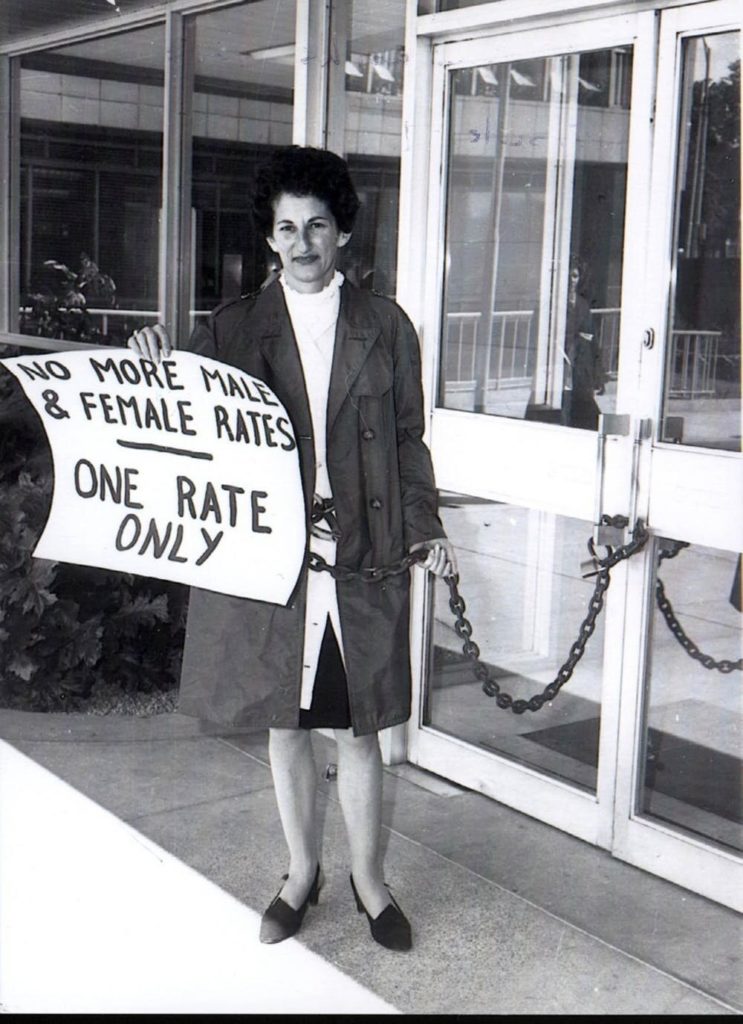
21 October 1969: Zelda D’Aprano chains herself to Commonwealth Building in fight for equal pay
On 21 October 1969, Zelda went to the Commonwealth Building and chained herself to the entrance. Other women activists marched up and down with placards chanting to draw attention to Zelda’s action, and the significance of equal pay.
1966: Women admitted to the Assistant Masters’ Association (AMA) – IEU history
In 1966, women were admitted to the Assistant Masters’ Association. The name changed to Assistant Masters’ and Mistresses’ Association (AMMA). Women and lay teachers in Catholic schools join in significant numbers. The name was changed to the Independent Teachers’ Association (ITA) in 1972 and then to NSW Independent Education Union in 1994. In 2016, the union operates as NSW/ACT Branch of Independent Education Union of Australia (IEUA). See IEU History for more!
1950: Union of Australian Women (UAW) established
The Union of Australian Women (UAW) was established in Sydney on 31 July 1950 as the successor to the New Housewives’ Association (NHA). The NSW branch was the first to be formed followed in quick succession by other state branches. A national organisation was formed in 1956. At the time, goals included:
improving the status of women and children,
disarmament and a halt to nuclear testing and mining,
equal distribution of wealth,
increased welfare services,
equal pay for women,
equality for Indigenous Australians,
abortion law reform,
and opposition to the White Australia Policy.
21 August 1943: First women elected to federal parliament
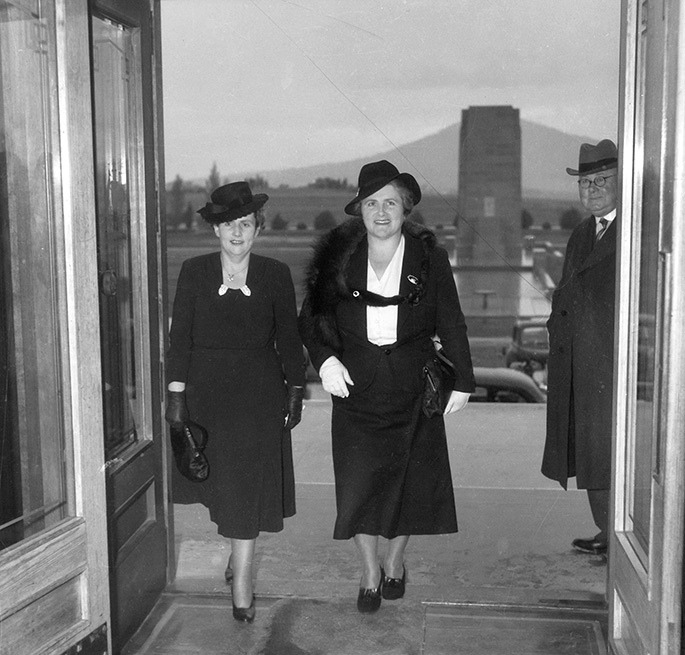
Enid Lyons (United Australia Party) and Dorothy Tangney (Australian Labor Party) became the first women to be elected to Australian federal parliament. Lyons won the House of Representatives seat of Darwin in Tasmania while Tangney was elected to the Senate for Western Australia.
1941: ACTU adopts Equal Pay as union policyat August Congress
In 1941, the Australian Council of Trade Unions (ACTU) officially adopted equal pay for women workers as a key demand, reflecting the growing movement for gender equality within unions. The policy was largely driven by the mass employment of women in industrial roles previously held by men during World War II. At the August Congress, the ACTU made campaigning for equal pay for women workers official union policy. Read more and watch video by union history Dr Liam Byrne.
11 January 1912: The Bread and Roses strike begins! (USA)
The power looms of the Everett Mill in Lawrence, Massachusetts, fell silent on January 11, 1912. When a mill official demanded to know why workers were standing motionless next to their machines, the explanation was simple: “Not enough pay.”
12 June 1902: Women given the right to vote in federal elections
The Commonwealth Franchise Act granted most Australian women the right to vote and stand in federal elections, a major step towards women’s suffrage. It also allowed women to stand for both Houses of the Federal Parliament. The Act excluded “aboriginal native[s] of Australia, Asia, Africa, and Pacific Islanders” (unless entitled under section 41) from voting. Despite being able to stand for election, it took until 1943 for the first women, Enid Lyons and Dorothy Tangney, to be elected to federal parliament.
1895: Women win right to vote and stand for election in South Australia
South Australia led the nation in women’s suffrage, becoming the first Australian colony to grant women the vote and the fourth place in the world to do so, just 18 months after New Zealand. Uniquely, South Australian women were also granted the right to stand for election, rights unmatched anywhere else in the world at the time.
1882: Australia’s first union for women founded
Australia’s first union for women, the Tailoresses’ Association of Melbourne, was founded at a meeting held in Trades Hall on 15 December 1882.