
The rights of working people were at stake in 2006 as the federal government sought to take them away through WorkChoices – and the union movement fought back.
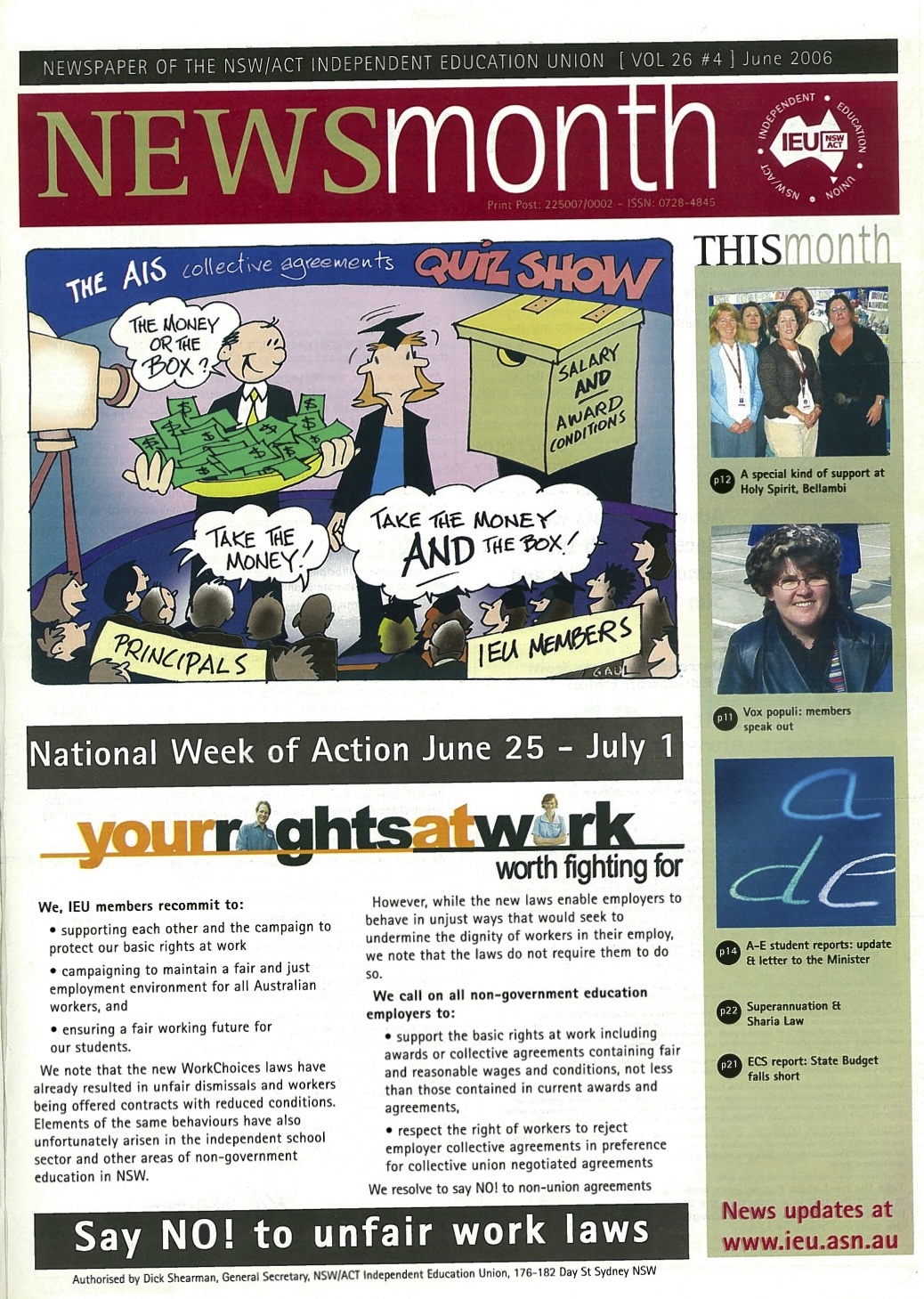
Your rights at work – worth fighting for
The union movement’s opposition to WorkChoices through the Your Rights at Work campaign dominates the pages of Newsmonth in 2006.
The Workplace Relations Amendment (Work Choices) Act 2005 came into effect on 27 March 2006.
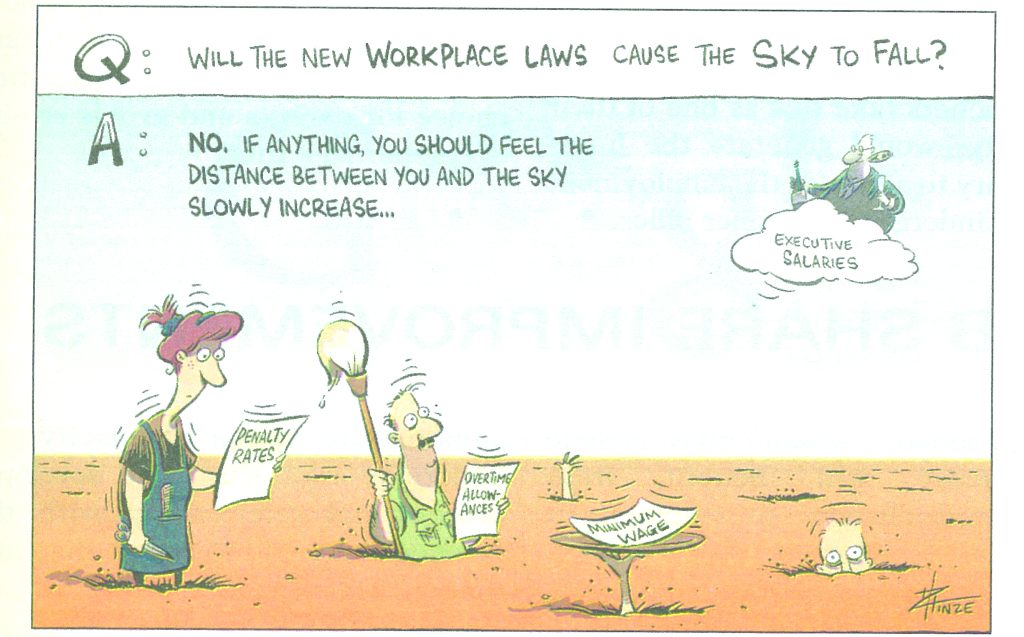
This legislation removed unfair dismissal protections for tens of thousands of Australian workers. It removed the “no disadvantage” test from industrial law which required that workers be no worse off under any new enterprise agreement. Penalty rates, long service leave and annual leave loading all came under attack.
WorkChoices attacked union power and restricted the rights of workers to take industrial action. WorkChoices promoted the primacy of individual employment contracts over collective agreements.
IEU members in many NSW independent schools were impacted as employers transitioned from the State Award into the federal industrial relations system. Members in numerous schools banded together to ensure their employers did not impose non-union agreements with inferior salaries and conditions.
Not all employers saw the attack on workers’ rights as a proper or moral position and numerous churches, including the Catholic church and the Uniting church opposed the legislation.
The then Bishop of Armidale, Kevin Manning, said the legislation was “spectacularly inadequate when tested against the principles of Catholic social teaching”.
The ACTU had launched its Your Rights at Work campaign in 2005 when the intent and detail of the proposed legislation had become known, led by then ACTU Secretary Greg Combet. Unions NSW was led by John Robertson.
The Your Rights at Work campaign has been acknowledged as playing an important role in defeating the Howard government in the 2007 election.
Newington College rallies against Work Choices
Newington College threatened to require teachers in senior promotion positions to reapply for their jobs with a significant diminution of salaries and conditions.
Strong action from the school’s IEU chapter, led by rep Michael Davis with support from the broader IEU, saw members from NSW, the ACT, Queensland and Western Australia send messages of solidarity to their colleagues at Newington.
Substantial media attention, including a visit from the Chaser comedic-satire team, brought a national focus to the potential impact of WorkChoices on teachers and school staff everywhere.
Union solidarity won the day, and teachers were not required to reapply for their jobs.
Three-band agreement
The IEU and the Association of Independent Schools (now called Independent Schools NSW) negotiated two model agreements for teachers in those schools determined to be in the federal system.
One agreement was based on the NSW Award and the other included a new progression system with only three bands and a newly created process to access Band 3.
Community preschools
Community preschools held a “Protest Play Day” on 8 April, wearing red to draw attention to the underfunding of the sector. Sound familiar? Check out our Start Strong Pay Fair campaign.
International solidarity
Union Aid Abroad – APHEDA reported on the work it was doing in Aceh, Indonesia, following the 2004 tsunami that devastated the region.
The IEU’s partnership with APHEDA goes back to the year it was founded in 1984. If you’re an APHEDA member, don’t forget to claim your donations on your tax return. If you’re not a member and would like to contribute to APHEDA’s work, visit: apheda.org.au.
A-to-E reporting
The federal government mandated A-to-E reporting, which was tied to government funding.
The union raised concerns with then Education Minister Julie Bishop about the inadequate timeline for implementation, the increase in workloads and the poor level of information provided to teachers.
Other concerns included that outcome-based reporting was inconsistent with A-to-E reporting and how it would work for students with special needs.
The union met with some employers who misunderstood the legislation as requiring increased numbers of parent-teacher evenings.
The year at a glance
- IEU membership: 27,461
- 2982 members joined the IEU in 2006; 20 years later, 467 are still members
- NSW Premier: Morris Iemma
- NSW Education Minister: Carmel Tebbutt
- NRL Premiers: Brisbane Broncos
- AFL Premiers: West Coast Eagles
- Academy Award Best Picture: Crash
- Booker Prize: The inheritance of loss, Kiran Desai
- ARIA Music Awards: Tea and sympathy, Bernard Fanning; Black fingernails, red wine, Eskimo Joe
- Australian of the Year: Professor Ian Frazer for his groundbreaking work in co-inventing the world’s first cervical cancer vaccine (Gardasil)
- Nobel Peace Prize: Muhammad Yunus and Grameen Bank – “for their efforts to create social and economic development from below” through providing small, collateral-free loans to impoverished people.
From the archives: Teachers learning from travel
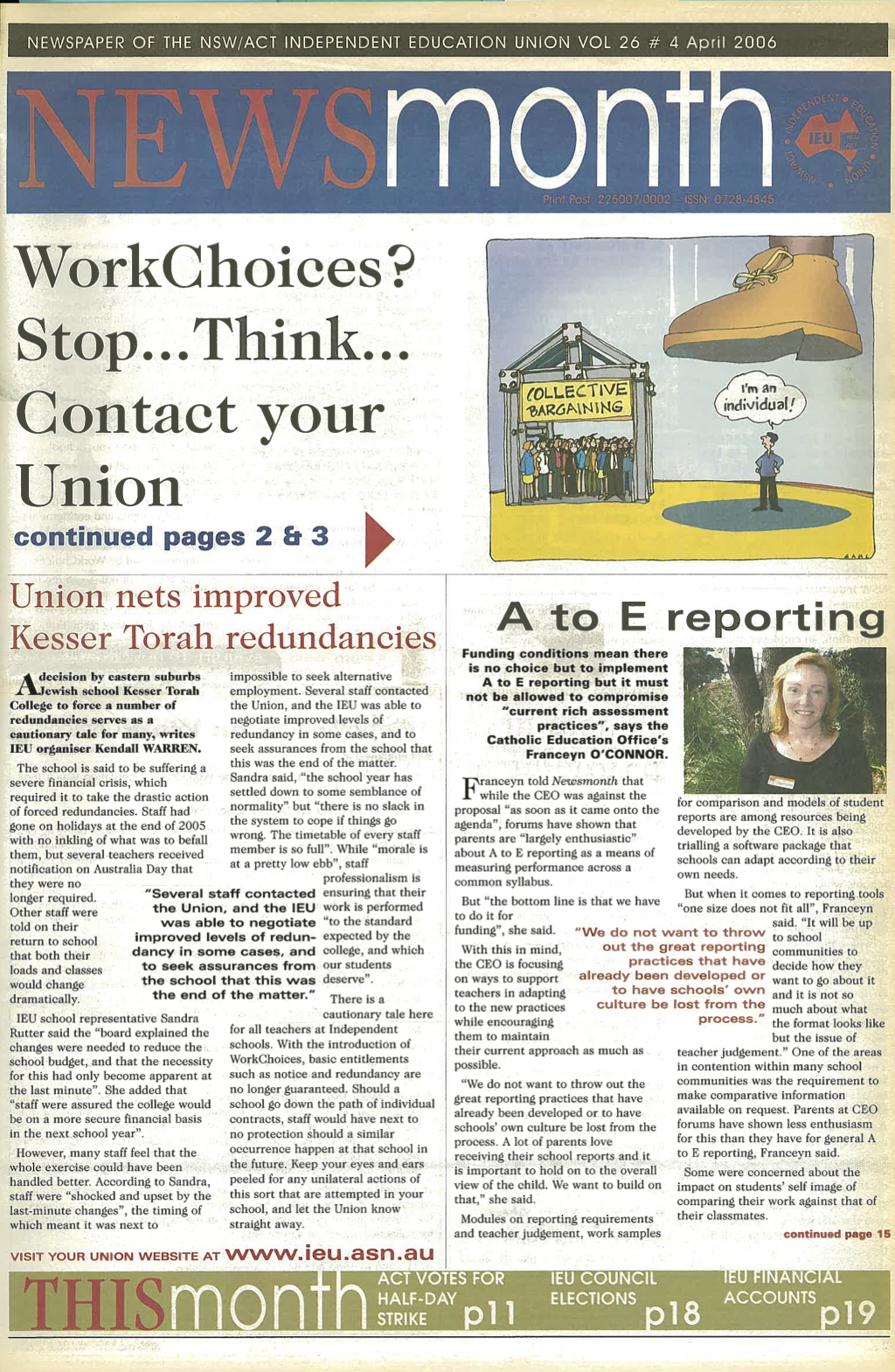
The Howard government’s radical overhaul of industrial relations laws, known as WorkChoices, featured strongly in the pages of Newsmonth throughout 2006
A cartoon published in one edition depicted a steel-framed house protecting the collective, while a boot hovered menacingly over the individual.
NSW government funding for community preschools was an issue, as it is now.
IEU Vice President Early Childhood Services Helen Inglis was critical of the 2006 NSW state budget: “The amount of money allocated is far short of what is required.”
“Sadly, a considerable sum has been allocated to encourage and support preschools to move to long day care,” she wrote.
Technological advances
Several members were invigorated by experiences overseas, including a teacher who went on a “fact-finding mission” to see social programs in Venezuela under the Hugo Chavez government.
He returned inspired by the ‘participatory’ model of government and keen to apply the principles in the classroom.
“In Venezuela… people get together to decide and discuss things,” he said.
The wonders of technology proved invaluable for teachers on exchange programs.
IT teachers from Canada and Australia used cutting-edge technology such as “Skype (an internet-based phone service)”, and “Google Earth (online maps and satellite images)”.
Both teachers “set up online public diaries (blogs) to document their travels.”
Our member found it wasn’t only family and friends reading his blog.
“We get people from all over the world reading it and writing to us about it,” he said. “It’s quite surprising to us!”
Cycling culture
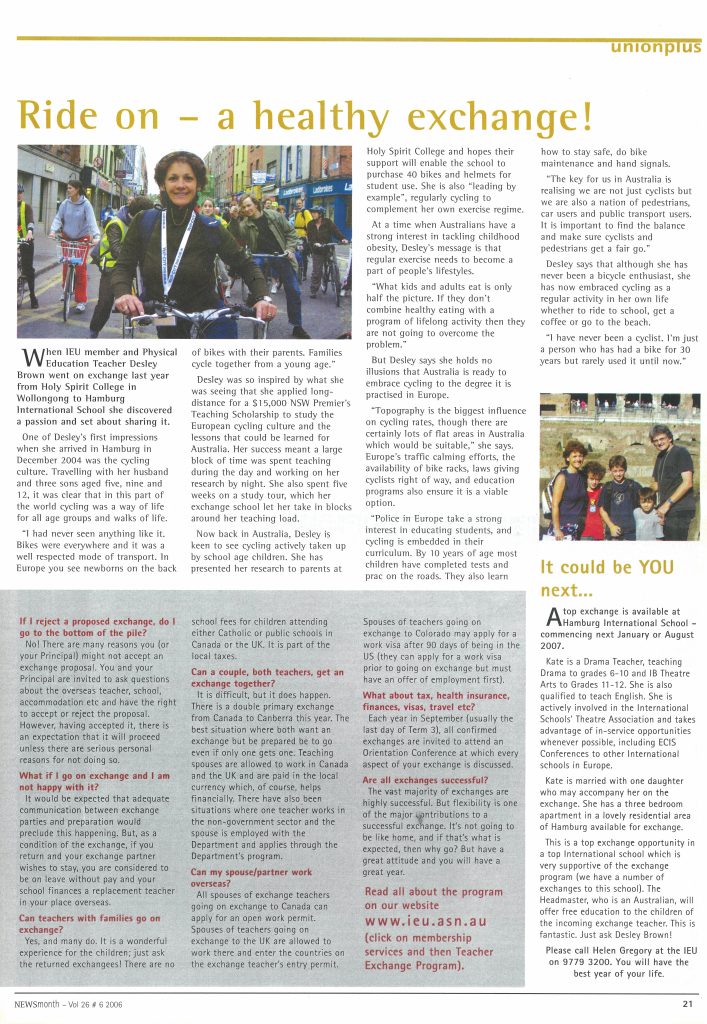
A later issue of Newsmonth featured a physical education teacher on exchange in Hamburg whose fascination with the city’s strong cycling culture prompted her to successfully apply for a NSW Premier’s Teacher Scholarship.
“Bikes were everywhere and it was a well-respected mode of transport,” she said.
“Families cycle together from a young age,”
she said.
She returned to Australia passionate about incorporating cycling into our culture and keen to ride the bike she’d owned for 30 years.
Teacher Pat Devery was also awarded a NSW Premier’s Teacher Scholarship to travel to Greece, Italy and the UK to develop his teaching of Ancient History. He encouraged colleagues to apply for such opportunities.
Of course, Pat is now an IEU Assistant Secretary after heading the union’s professional development program for many years.
Published in the July 2026 edition of Newsmonth. Compiled by Dave Towson (Deputy Secretary), Monica Crouch (Managing Editor) and Tania Yardley.
More IEU History
-

Time capsule: 1986
As 1986 began, the NSW Independent Teachers Association (ITA), as our union was then known, had 12,103 members – and 2035 more joined throughout the year. Today we have more than 32,000 members. Of those who joined in 1986, 85 are still members and will receive their 40-year membership gift this year. It was the…
-

Time capsule: 2015
In 2015, former US President Barack Obama still occupied the White House. The Lodge in Canberra, however, had new tenants after Malcolm Turnbull successfully challenged Tony Abbott for the prime ministership after the Abbott-led government recorded 30 consecutive losses in Newspoll. The ‘fixer’, Christopher Pyne, was the federal education minister, while his NSW counterpart was…
-

Time capsule: 1985
They’re probably not two people you’d expect to see in the same sentence, but the year was 1985, and China’s leader Deng Xiaoping was the Time Person of the Year while actor and comedian Paul Hogan was Australian of the Year. It was a big year for literature, with author Margaret Atwood publishing The Handmaid’s…
-

Time capsule: 2005
Prime Minister John Howard was at the height of his power in 2005 after his government attained a majority in the Senate following the previous year’s federal election. However, 2005 marked the beginning of the end of the federal Coalition government after it introduced draconian industrial relations legislation. Dubbed WorkChoices, it sought to severely restrict…
-

Time capsule 1995
In a semi-regular column, we delve into our Newsmonth archives to uncover what stood out in the union, the teaching profession and the education sector, as well as politics and culture. Here we wind the clock back 30 years to 1995. It was a year when Paul Keating ruled the roost in Canberra, while Bob Carr began…
-

Statement on the passing of John Quessy
The IEU is deeply saddened by the passing of former Secretary John Quessy on Sunday 10 December. John joined the Independent Teachers Association (now the NSW/ACT Branch of the IEUA) as a student member in 1975. He became a teacher at St Pius X Chatswood from 1976 to 1994, where he taught English, history, art…
-

Time capsule 1981
In a semi-regular column, we delve into our Newsmonth archives to uncover what stood out in the union, the teaching profession and the education sector, as well as politics and culture. Here we wind the clock back 40 years to 1981. In 1981, the IEU was known as the Independent Teachers Association (ITA), boasting a total membership…